
Traffic Warrants in Clinch County
A Clinch County traffic warrant is court process, full stop. It is not a driving-history report. It usually follows a missed court date or a citation left unanswered, and the paperwork may carry the label warrant, bench warrant, or capias, which is an arrest command tied to failure to appear. Whatever the label, only the issuing court controls what it means and whether it still stands. Georgia Courts reports that the state has no centralized traffic-citation database, which makes the citation itself your best routing document. Read the city, the issuing agency, the court, the date, and the citation number before you call anyone. Homerville publishes a municipal clerk and a payment portal; Argyle lists a court contact. Fargo and Du Pont citations have to be routed straight through the issuing court or the Clinch County Sheriff.
Clinch County Has No Central Ticket Search
The Georgia Courts ticket page notes that connected court systems may allow a search by name, city or county, and date of birth, and it warns that a citation can take 7 to 21 business days to show up. That is a statewide picture. It does not mean every Clinch County court uses the same tool.
Quick answer: A missing online ticket is not proof that no Clinch County traffic warrant exists.
When a search turns up nothing, call the issuing court in Clinch County. If the court date has already passed, ask point-blank whether failure-to-appear process was entered and what the court wants next.
How to Check for a Traffic Warrant
Start with the issuing court, not a generic license or record product. In Homerville, the municipal-court clerk answers at 912-487-5306 ext. 1301, and Argyle Municipal Court lists (912) 422-4789. The Clinch County Sheriff's general number, 912-487-5316, is the county law-enforcement fallback. The sheriff posts no dedicated warrant line or online roster.
- Gather the citation, full name, date of birth, issuing agency, and court date.
- Call the court on the citation and ask whether warrant or capias process is shown.
- Use the Clinch sheriff to ask about county law-enforcement status and service routing.
- Use a focused Open Records request for a releasable record or policy, not instant status.
- Check DDS separately if a failure-to-appear suspension notice exists.
Showing up in person can end in custody. Anyone worried about arrest in Clinch County should get legal advice before walking up to a court or sheriff counter.
Homerville Traffic Portal Limits
The Homerville Government Window portal handles Traffic Tickets payments, and its official FAQ is clear that the vendor is a third-party processor, not legal authority. It takes certain electronic payments, but it cannot set up a payment plan online or by phone when full payment is not made. A Pay button may also sit unavailable when a court date is scheduled or missed; the FAQ directs the user back to the clerk. So a Clinch County ticket that is not fully payable should go through the municipal clerk, not the portal. The portal belongs to Homerville alone, and it should not be used for Argyle, Fargo, or Du Pont unless the issuing court confirms it accepts the ticket. Note: paying through a vendor does not itself prove that a court recalled a traffic warrant.
What a Traffic Warrant Shows
Clinch County publishes no traffic-warrant results online. Treat any field list as a request checklist, not a local database. A mark like UTC-YYYY-##### is illustrative only, since the county's format is not published.
| Citation or case number | The key assigned by the issuing agency or court. |
|---|---|
| Issuing court | The court that controls the process and next appearance. |
| Violation and date | The releasable citation description and event date. |
| Failure-to-appear date | When the court recorded a missed required response, if applicable. |
| Bond or appearance direction | Current instructions confirmed by the court. |
| Status and verified date | Active, served, recalled, or satisfied, tied to a fresh check. |
Clinch County Missed-Date Scenario
If a traffic date passed, contact the issuing clerk at once. Ask whether the court entered a warrant or capias, whether online payment was disabled, what appearance or filing is required, and what record will show a recall. Assume no courtesy notice and no grace period. Georgia misdemeanor citation materials allow a warrant after failure to appear absent a sufficient excuse, subject to the court's process. In Homerville, go through the municipal clerk instead of forcing payment through the portal. In Argyle, call the court. When Fargo or Du Pont appears on the citation but no court is clear, ask the city contact or the Clinch County Sheriff to identify the right office. A clerk in Clinch County can explain public procedure but cannot give legal advice.
Paying or Lifting a Traffic Warrant
Paying, recalling a warrant, and closing a case are three separate acts. A court may want an appearance, bond, full payment, a motion, or some other lawful step, and Clinch County publishes no warrant-recall form, local bond schedule, payment-plan form, surrender calendar, or general pay-and-clear menu to tell you which. Ask the court what applies to the exact citation. Uniform Magistrate rules recognize cash, property, recognizance, and professional surety bond while allowing restrictions, but that statewide framework does not reveal a local amount or an accepted instrument. The court sets the bond question. When surety is allowed, the sheriff decides whether a proposed surety is acceptable.
Before paying: Ask whether payment resolves only the citation or also produces a court order recalling any traffic warrant.
DDS Failure-to-Appear Timeline
The Georgia DDS failure-to-appear FAQ states that a suspension takes effect 28 calendar days after DDS receives court notice. Resolve the citation before that date if you can. Most courts send releases electronically, though the court remains the source for the citation disposition. The page lays out the state administrative layer that sits behind any Clinch County ticket.
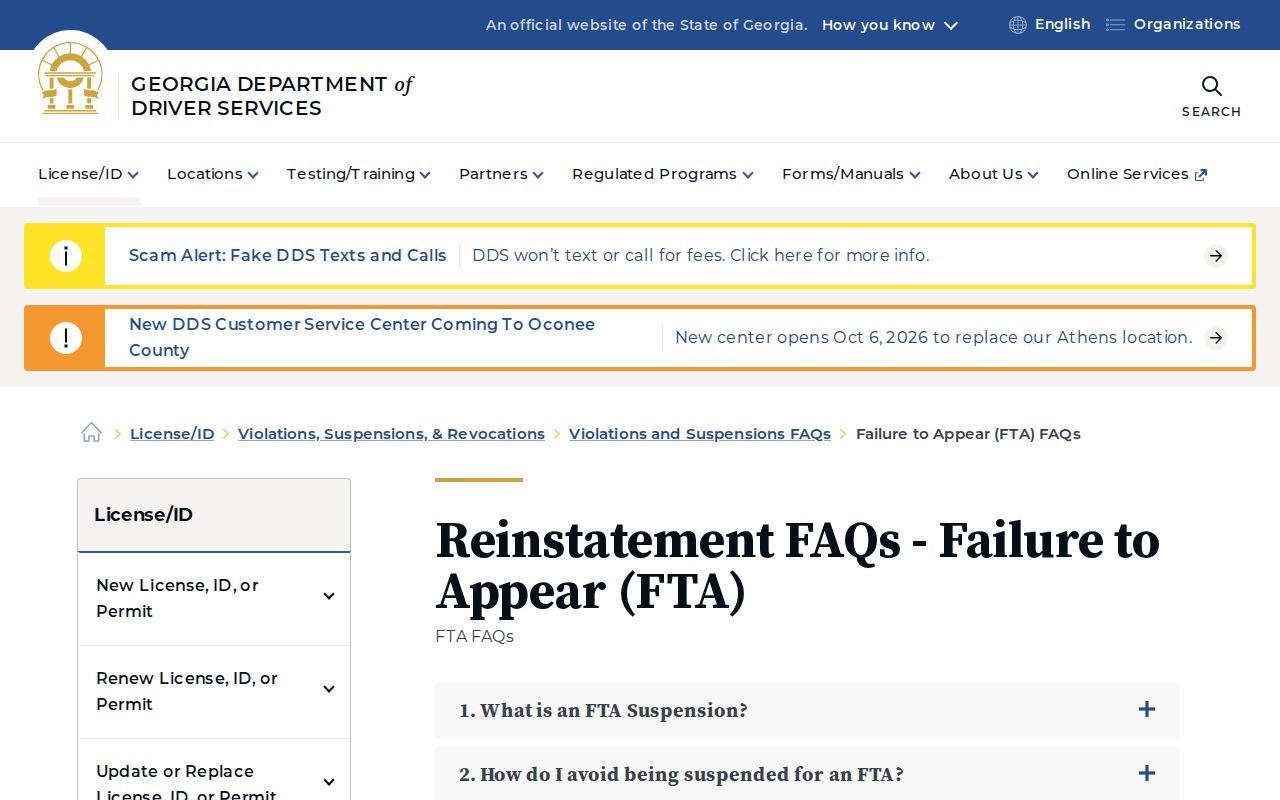
Court resolution and DDS reinstatement are two separate checks. Each office keeps its own file. Confirm both records. Keep the court disposition, any recall order, the payment receipt, and the DDS confirmation as separate documents for a Clinch County case. If dates or status labels conflict, ask each office when its system last received an update and which step remains open.
Traffic Warrant vs FTA and License Holds
Three records run on separate tracks. The Clinch County court holds the citation and any warrant. DDS owns the administrative suspension and reinstatement record. A payment vendor transmits your funds but has no power to recall judicial process.
| Record | Who Controls It | What Confirms Resolution |
|---|---|---|
| Traffic citation | Issuing court | Court disposition |
| Traffic warrant or capias | Issuing court, with service by law enforcement | Recall, dismissal, service, or other official status |
| DDS FTA hold | Georgia DDS after court reporting | Court release received and DDS requirements completed |
| Portal payment | Payment processor | Receipt only, unless the court separately updates its record |
Clinch County Traffic Record Access
The Georgia Open Records Act, O.C.G.A. § 50-18-70 et seq., opens the door to nonexempt public records in Clinch County. It is not a same-minute warrant-status tool. Nor can it recall process. A narrow, well-built request can still get you a traffic-warrant policy, a blank form, a retention schedule, or a releasable court record. Be specific. Name the court or agency, the date range, the citation number if you know it, the record class, and your preferred format. Ask for segregable nonexempt portions too. Request a legal basis for anything withheld, since protected identifiers, juvenile records, and investigative content may stay restricted. If it lacks the record, ask who holds it. Note: A public copy can be old; confirm current traffic-warrant status directly with the issuing Clinch County court.