
How to Search Clinch County Warrants
Georgia's existing-warrant instructions point you to the local sheriff, so have a first and last name, date of birth, and the county ready before you dial. In Clinch County that means the Sheriff's Office at 912-487-5316. Ask three things. Can the inquiry be handled by phone? What jurisdiction was checked? Which court issued the process? Keep in mind the number is a general line rather than a dedicated warrant desk. The state guidance also notes that some offices require a visit in person, and that a person who walks in on an active warrant may be taken into custody. Anyone who suspects a warrant exists may want to talk with a lawyer before deciding between an in-person search and a surrender plan.
- Prepare the complete name, date of birth, and Clinch County connection.
- Call the sheriff and ask how current existing-warrant checks are handled.
- Contact the issuing clerk if the matter is Superior, Magistrate, or municipal.
- Use a precise Open Records request when a releasable document or policy is needed.
- Confirm current status and resolution steps with the responsible court or agency.
No Clinch County Online Warrant Index
Clinch County publishes no active-warrant roster, no most-wanted list, no jail lookup, no warrant application, and no anonymous status screen. Every check runs through a person, not a webpage. And because no county page exists to return a name, a missing name on a website proves nothing at all.
Quick answer: Call the sheriff first, then follow the record to the court that issued or received it.
The sheriff may know a warrant's operational status while the clerk holds the actual court file. In Clinch County, ask each office which source supplied the answer and when staff last checked it.
Clinch County Warrant Search Fields
Clinch County has no online search form of its own. That means the usual portal field labels can't be confirmed here. The table records only what Georgia's official guidance and local court routing support, without inventing a local web form that does not exist.
| Field Label | Type | Required | Notes |
|---|---|---|---|
| First and last name | Identity detail | Prepare it | Use the complete legal name when known |
| Date of birth | Date | Prepare it | Helps staff distinguish similar names |
| County | Jurisdiction | Prepare it | The sheriff’s result may be county-limited |
| Case or citation number | Record key | If known | Useful when contacting the issuing clerk |
| Issuing court | Jurisdiction | If known | Controls where the court record and next step are found |
Never send sensitive identifiers through an unverified email or a vendor form. Instead, ask the Clinch County office directly what it needs and how it accepts the information.
Clinch County Sheriff Versus Clerk
The sheriff and the court clerks answer different questions in Clinch County. For an existing county warrant, the sheriff is the best first call, and the office can say whether it checks by phone or requires a visit. The Clinch Superior Clerk keeps Superior criminal cases and criminal warrants. Magistrate Court, for its part, handles arrest and search warrants, preliminary hearings, good-behavior warrants, bad-check warrants, and bail within its authority.
| Channel | Best Use | Verified Contact |
|---|---|---|
| Clinch Sheriff | Current county law-enforcement inquiry and service routing | 912-487-5316 |
| Superior Clerk | Superior criminal docket and warrant records | 912-487-5854 |
| Magistrate Court | Lower-court warrant and preliminary-hearing records | 912-487-2514 |
| Homerville clerk | Homerville traffic or ordinance process | 912-487-5306 ext. 1301 |
| Argyle Court | Argyle municipal matters | (912) 422-4789 |
What a Clinch Warrant Search Returns
A phone or clerk inquiry rarely returns every document in a warrant file. Ask for the issuing court, the record identifier, warrant type, issue date, current status and its date, plus any public bond or appearance direction. Supporting affidavits, evidence, recordings, and personal details may be restricted or redacted. Clinch County publishes no official number pattern, so a sample like YYYY-W-##### is only a format illustration, never a real Clinch identifier.
| Warrant or case number | The office’s record key; verify it with the custodian. |
|---|---|
| Issuing court | The court that controls its own process and record. |
| Type and date | Shows what process was issued and when. |
| Legal description | May be limited to a releasable charge or citation description. |
| Status and status date | Distinguishes active, served, recalled, satisfied, or transferred records. |
| Bond or next step | Must come from the authorized court or agency. |
Clinch County Court Map in Practice
The Georgia Courts navigator lays out the state's trial-court levels. One search cannot cover them all. Clinch Superior Court holds the broad felony trial role. Magistrate Court issues warrants and runs the lower-court steps. Municipal courts take traffic, ordinances, preliminary hearings, and warrants in their own sphere. The official court map helps you match paperwork to the right level.
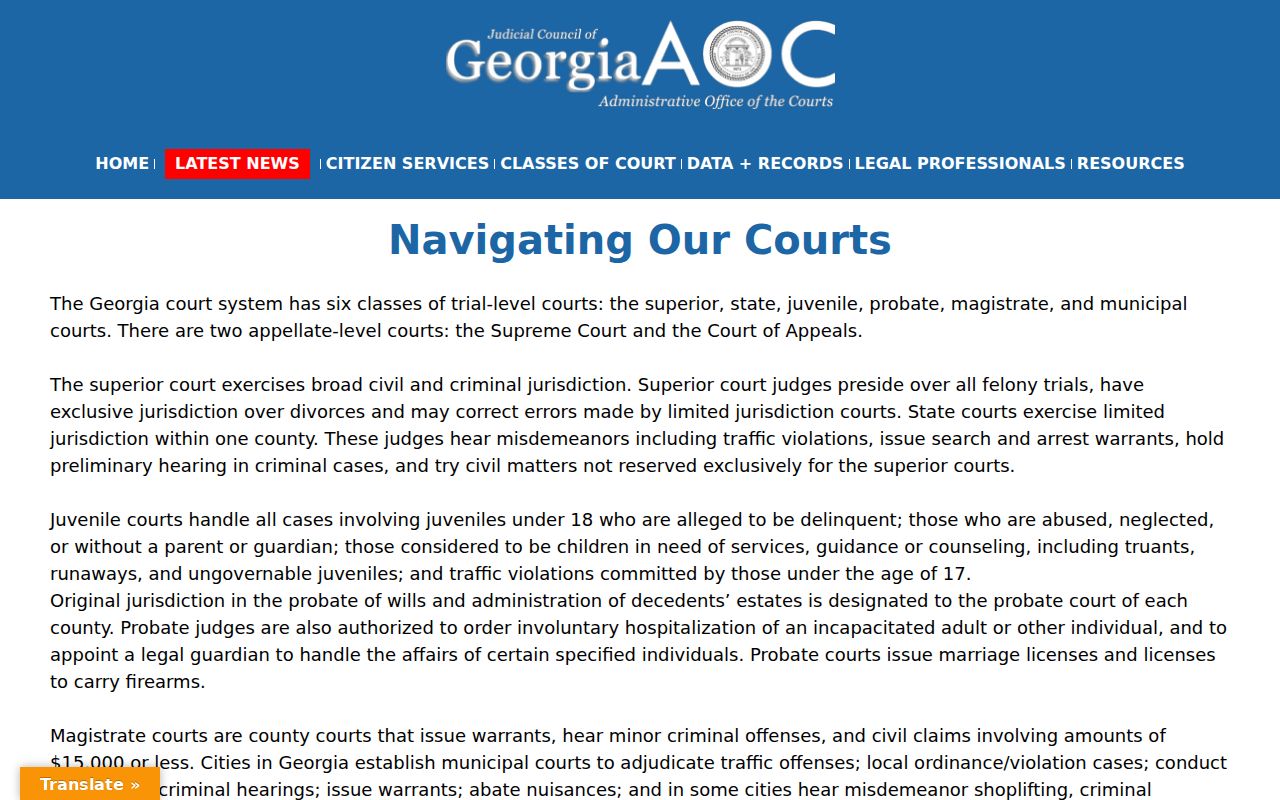
That level tells you which clerk to call. Still, verify the exact Clinch County office, because a record can transfer from Magistrate Court up to Superior Court.
Where Clinch County Warrants Are Checked
Homerville's Court Square holds most of the key offices. The Clinch County sheriff sits at 115 Court Square, the Superior Clerk at 25 Court Square, Suite C, and Probate and Magistrate Court at 110 Court Square. They are steps apart but form no single public index. If the sheriff refers you to a clerk, ask whether the referral concerns a court file, a transfer, or issuing-court authority. Municipal cases follow a city path instead. Homerville publishes a police and municipal-court clerk contact. Argyle posts a court page. Du Pont and Fargo offer no public warrant interface, and the regional plan assigns contract sheriff coverage there. Federal paperwork belongs to the Middle District of Georgia, Valdosta Division, PACER, or the named agency. Georgia Courts e-access is an account-based court-record route, not a statewide public warrant search.
Clinch County Records Requests Differ
A status inquiry asks whether current process shows against someone. An Open Records request asks a custodian to inspect or copy releasable records. Different tasks, different timing, different limits. Clinch County's official request form lets you describe the records, choose inspection and copying or copies alone, and request a timetable. Name the custodian, date range, record class, and format you want. Ask for segregable nonexempt portions and the legal basis for each withholding. The local form describes the first 15 minutes of administrative work as free and gives general copy-charge language, though it lists no submission email or online intake. Confirm the delivery route before sending anything. Note: An Open Records response can supply a record or policy, but it does not recall, dismiss, or satisfy a warrant.
Clinch County Warrant Status Codes
Clinch County posts no live status screen. Each term must be confirmed with the responsible office, along with a verification date.
- Current or active
- The office still treats the process as open.
- Served or executed
- An officer acted on the warrant and may have returned it to court.
- Recalled
- The authorized court withdrew the process.
- Satisfied
- The responsible office recorded completion of the obligation.
- Transferred or bound over
- The case or original warrant moved from a lower court to a trial court.
Want a real answer on a Clinch County warrant? Ask the office that holds it for current status. A receipt, an old copy, or a blank search from one office proves nothing either way.
Access and Restricted Warrants
Clinch County warrant records sit inside a framework set by the Georgia Open Records Act. That law lets you inspect and copy public records unless a statute or court order says otherwise. Warrant files often hold protected identifiers, investigative details, affidavits, evidence, or recordings. Those pieces can be redacted or withheld. Juvenile court and law-enforcement juvenile records face even tighter limits. A brand-new or unserved warrant may not come out through the same channel as an older court entry. An original Magistrate warrant can also land elsewhere after a transfer. So when you ask, confirm the office still holds the record and that any result shows present status.
Key rules:
Restricted or sealed material does not appear merely because a public request was filed.
Juvenile process is not part of an ordinary adult warrant-record search.
No result from one office is not proof that no Clinch County warrant exists.